
Presbyterian Peace Fellowship Statement on American Islamophobia
In recent months there has been an alarming uptick in anti-Muslim and anti-Islam rhetoric in the United States. This hateful messaging is rampant on social media outlets, and it is being employed by politicians—including the President of the United States and sitting members of Congress—who, in the last year, have posted well over a thousand statements on social media demonizing Muslims. In August, conservative agitator Jake Lange led a “Crusader March” in Dearborn, Michigan, a city with large Muslim and Arab populations; and self-identified Christian nationalist worship leader and provocateur Sean Feucht led a “Jesus March” through an outdoor Muslim religious observance in Chicago. During the lead up to 9/11 commemorations in New York, politicians and pundits–inluding former New York City mayor Rudi Giuliani–used Islamophobic slurs to connect New York City’s current mayor–Zorhan Mamdan, who is Muslim–to the terrorists who attacked the World Trade Center.
These words and actions present Muslims as being un-American and anti-Christian usurpers of democratic norms who are seeking to replace the United States constitution with Sharia law. In some cases, American politicians and media personalities are calling for Muslim observances to be outlawed and for Muslims to be expelled from the United States.
These expressions of anti-Islamic hate are ignorant, dangerous, and cause for serious concern. If political leaders in another country were articulating such alarmist bigotry, and if prominent religious leaders were acting in such a confrontational manner, it would be a cause for apprehension in the international community, as well it should be.
To scapegoat minority communities as a way of ginning up political power and societal control is the favored playbook of authoritarian regimes throughout history. Those who study genocide and other crimes against humanity inform us that such hateful rhetoric and aggressive confrontation and political repression often are harbingers of genocide and other crimes against humanity.
We would be especially concerned if we were seeing such religious animosity from political and faith leaders in a country with a history of genocide and other crimes against humanity. The United States has such a history.
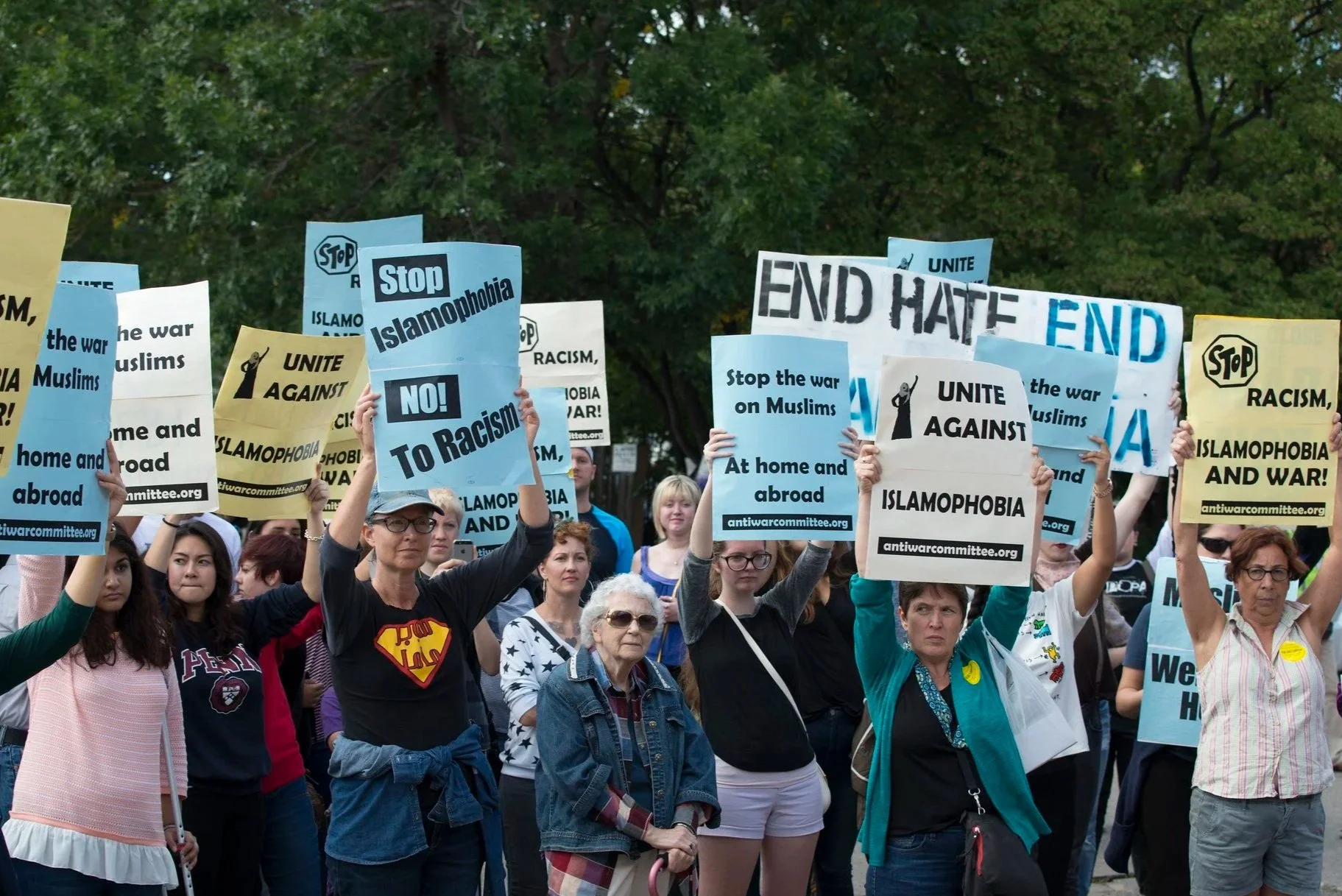
"Protest against Islamophobia and hate speech" by Fibonacci Blue is licensed under CC BY 2.0.
Remembering that the Book of Confessions calls us to “approach all religions with openness and respect” (Confession of 1967, 9.42). Presbyterian Peace Fellowship calls on Presbyterians to speak and act on behalf of our Muslim neighbors. As communities, we must reach out to and forge relationships with Muslim neighbors. As people of faith we must pray with and for Muslims in our cities, towns, and neighborhoods.
In obedience to Jesus who directed us to love as neighbors those we might otherwise despise (Luke 10: 25-37) and who taught us that God loves the whole world (John 3:16-17), we must use our pulpits to proclaim a message of love for neighbor that protects our Muslim friends and loved ones in practical and tangible ways. In our Church councils, Presbyterians must denounce anti-Muslim bigotry, and in our institutions, we must resist every political and societal movement that promotes violence against our Muslim neighbors or limits the practice of Islam in any way.
The time to speak words of welcome, inclusion, and peace is now.