
Venezuela: Seeking Clarity in the Midst of Chaos
by Neddy Astudillo
When U.S. residents awoke on Saturday, January 3, we learned that our government had attacked Venezuela and captured its president and first lady. Within a few days, the PPF Peace Church Working Group had posted worship resources on social media, drafted a statement denouncing the action, and organized a webinar for the following weekend.
The webinar, which aired on January 10, drew more than 60 participants, and included South American and U.S. perspectives. The Rev. Dr. Neddy Astudillo is a Venezuelan eco-theologian and Presbyterian pastor based in the U.S. She is the coordinator of the Spanish Climate Justice and Faith Program at the Pacific Lutheran Theological Seminary.
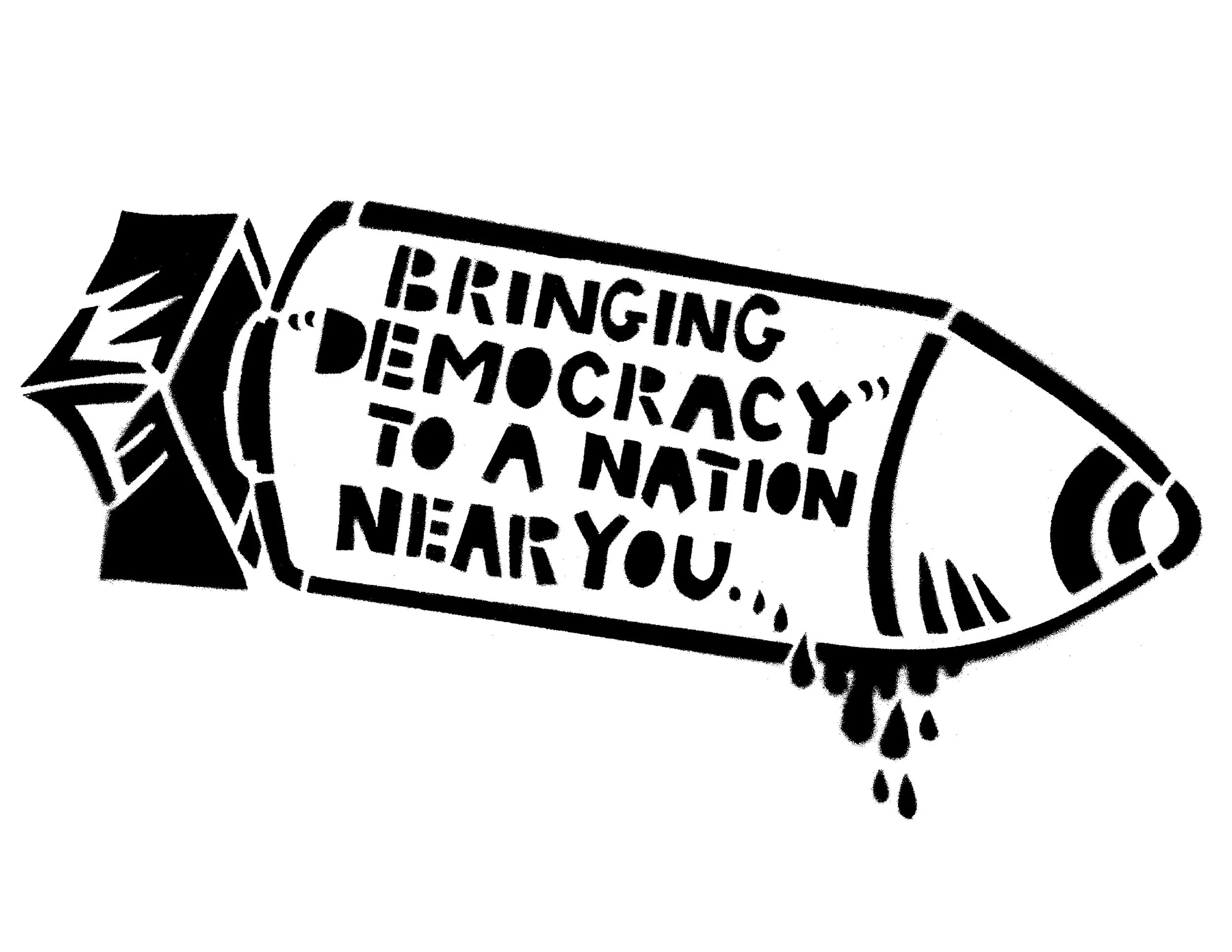
Bringing Democracy by Nicole Schulman
When I was thinking about the title of our gathering, Faithful Responses for Churches and Individuals, I thought of different populations – Latino churches, Anglo churches, Venezuelans in exile, and people in Venezuela. And I realized that the same narrative doesn't fit all. There is a lot of pain, frustration, fear, hunger, and hunger for justice that need to be respected and held with compassion. Following Ezekiel's wisdom of a time for everything, the reality is that different people are interpreting this time from different perspectives. There are people with whom I cannot have a reasonable conversation yet, from all sides. But for those who are seeking discernment and clarity in the midst of a very chaotic developing situation, there are a few things that I think we can all keep in mind. One is that most Venezuelan people want a prosperous Venezuela. How we get there and what it means is a matter of debate.
I have been challenged and need to clarify where I speak from. I am a pastor. I am a Christian. I am a Venezuelan and U.S. citizen. I studied sociology and lived in Venezuela until age 24. I left Venezuela before Chavism began. I have lived in the U.S. for the last 33 years and visited Venezuela several times, but my last time was in 2011. A quarter of my family have migrated to the US. A handful are US residents or citizens, but most have temporary protection status. I am an environmentalist and I have been working on environmental and climate justice issues since before I came to the U.S.
How I faithfully respond to churches and people about Venezuela depends on who I talk to. And here are some conclusions for me where I am standing today. If we want to talk about Maduro, we can avoid the use of the word “president” and acknowledge the repressive measures that he has taken to stay in power. If we want to talk about U.S. colonialist power, we also need to recognize the presence of China’s and Russia’s interest in the country. When we seek to be in solidarity with Venezuelan people, let's not only talk about those suffering in Venezuela, but also the 600,000 in the US who recently lost their temporary protection status and are living in fear that they may be deported and separated from families, jobs, careers, and properties. People are not ready to go to Venezuela. Let's defend immigrants’ rights while they are here in this country. Most Venezuelans that celebrate U.S. military actions do so because they are tired of international diplomacy efforts that have borne no fruit. In the last few days, I have several good friends in the United States that have come to me and said lovingly, "I've been thinking of you." To that I need to respond, “I have also been thinking of you.”
The crisis in Venezuela is either crisis as chaos or crisis as opportunity. I think it is the clearest it has been in many years of how our history in Venezuela and the US have been tied for a very long time. In my young years, it was through the International Monetary Fund lending millions of dollars to Venezuela's governments, but requiring social measures that kept Venezuelans dependent on international investments and corporations to refine Venezuelan oil. One of those IMF requirements was to continue using leaded gasoline for many years in Venezuela in spite of the fact that the U.S. knew the damage that lead has on human health. This was while U.S. oil corporations ruled Venezuela's oil companies. We had 80% poverty and repression and we imported 90-95% of our food. We abandoned the rural areas and our knowledge of how to grow our own food.
Today, Venezuela also suffers high levels of poverty, but is producing almost 100% of its food. I don't say this to say that Maduro's government is good. I say this because I am concerned that when Trump says that Venezuela will have to buy U.S.-made products, it means that Venezuela's food security will go down the drain once again. So what does it mean for Venezuela that now it needs to buy U.S. products? I don't think that we know that yet. But this morning I received an AI produced video saying that now Walmart, Target, Amazon, Starbucks, Pfizer and other companies were going to start doing business in Venezuela. Who will produce these products? Who will make sure that people get paid fair wages? Who will provide medical insurance? Where will the waste from these products go? Who will be responsible for building waste management facilities? From the reality, one can understand why Chavez decided to nationalize the oil industry and not renew contracts with US oil companies.
I will end with this. A faithful response from U.S. citizens means knowing your history of economic intervention and U.S. sanctions in Venezuela. It means leaving behind the era of colonialism and empire building by working for climate justice where we move away from fossil fuels. We must even question the advances of the green economy that threaten to develop new types of extraction in other people's lands, eroding democracies and indigenous people's rights, like is happening now with the lithium for solar panel batteries and minerals for EVs.
The situation is complicated but we are all involved. A faithful response is staying in the challenging conversation and searching for a just transition – not just an energy transition but one where the sovereignty of the countries and lands and peoples and governments is respected and where we all seek a better life and a sustainable future.
Don't just think of me. Think of how our lives have been intertwined for many, many, many years. Some say up to 500 years. I am concerned that President Trump’s project is to turn Venezuela into a country of major consumers. If so, we should consider divesting from these oil companies and boycotting oil. Don't just think of me. This military, police, and economic intervention in Venezuela touches on the limits of the planet. So, it is an issue that should involve all of us. As an AP news article said this morning, President Trump, both in his first and now second term, has repeatedly dismissed the scientific consensus on climate change and rolled back environmental and clean energy policies. And Venezuelan oil is one of the dirtiest crudes that exist. To produce it alone can mean more emissions of carbon into the atmosphere. I am concerned about what this means for Venezuela, but also for the world. Democracy is needed for a sustainable future and we need to keep working to protect democracy on U.S. soil as we seek justice for Venezuela.
Watch the entire webinar on Venezuela on the Presbyterian Peace Fellowship YouTube channel!